What does an adjuster do for your home insurance?

An adjuster plays a crucial role in the context of home insurance claims. When you experience damage to your home or property covered by your insurance policy, an adjuster is assigned by your insurance company to evaluate the extent of the damage and determine the amount of compensation you are entitled to receive. Here are the primary responsibilities of a home insurance adjuster:

Damage Assessment: The adjuster visits your property to assess the damage caused by an insured event such as a fire, storm, water leak, or vandalism. They examine the affected areas, document the extent of the damage, and take photographs or videos as evidence.

Investigation: The adjuster investigates the cause of the damage and determines whether it falls under the coverage outlined in your insurance policy. They review the policy terms, conditions, and exclusions to ascertain the applicability of the claim.

Documentation: The adjuster helps you with the paperwork required for your claim. They assist in completing claim forms, gathering necessary documents, and providing guidance on any additional information or evidence needed to support your claim.

Estimation of Loss: Based on their assessment of the damage, the adjuster prepares an estimate of the cost required for repairs or replacement. They consider factors such as labor, materials, and local market rates to determine the value of the loss.

Support and Guidance: Throughout the claims process, the adjuster serves as a source of information and guidance. They answer your questions, address concerns, and help you understand the terms and procedures involved in the insurance claim.

It’s important to note that there are different types of adjusters, including company-employed adjusters, independent adjusters, and public adjusters. Their roles and responsibilities vary based on their affiliation and the specific circumstances of your claim.

To get a quote or discuss how we can help you with choosing your home insurance provider, call us at (800) 234-2103 or get a free 30 second quote on westernmutual.com.

How to Create a Thorough Home Inventory

Having a complete home inventory is crucial for protecting your assets in case of fire, theft, or natural disasters. A well-documented inventory helps ensure you receive full compensation from your insurance provider. One of the best ways to make your inventory more effective is by including video documentation. In this guide, we’ll walk you through the step-by-step process of creating a home inventory that covers everything an insurer might need. 

Why You Need a Home Inventory 

A home inventory serves as proof of ownership, helping you: 

-Accurately file insurance claims. 

-Determine the right amount of coverage for your belongings. 

-Speed up the claims process in case of loss. 

-Provide documentation for tax or estate purposes. 

Step 1: Choose a Home Inventory Method 

There are several ways to organize your home inventory: 

Home inventory apps – Apps like Sortly, Encircle, or Nest Egg help categorize and store digital records. 

Spreadsheets – A simple Excel or Google Sheet can be used to log item details, including value and receipts. 

Notebook & Folder – A handwritten inventory can be paired with printed receipts and photos stored in a safe place. 

Step 2: Go Room by Room 

Organizing your inventory room by room ensures that you don’t miss anything. Start with the most valuable or high-risk items, such as electronics, appliances, and jewelry, and then move on to everyday household items. 

What to Record: 

-Item name 

-Description (brand, model, serial number) 

-Purchase date & location 

-Estimated or actual value 

-Receipts or appraisals (if available) 

Step 3: Take Photos and Videos 

Visual documentation adds extra credibility and proof of ownership. Here’s how to do it right: 

Taking Photos: 

-Capture close-ups of high-value items. 

-Photograph model numbers and serial labels. 

-Group items together for context (e.g., a bookshelf with all its contents). 

Recording a Video Walkthrough: 

-Walk slowly through your home, recording every item. 

-Verbally narrate details about expensive belongings. 

-Capture the condition of furniture and fixtures. 

Step 4: Store Your Inventory Securely 

Your home inventory should be protected to ensure it’s accessible when needed. 

-Save to Cloud Storage – Use Google Drive, Dropbox, or iCloud for easy access. 

-Keep a Physical Copy – Store printouts in a fireproof safe or off-site location. 

-Share with a Trusted Person – Consider sharing a copy with a family member or insurance agent. 

Step 5: Update Regularly 

Your home inventory is only useful if it remains accurate. Set a reminder to: 

-Update it annually. 

-Add new purchases as you acquire them. 

-Remove old or donated items. 

Final Thoughts 

Taking the time to create and maintain a home inventory can save you significant stress and financial loss in the future. By including photos, receipts, and especially video documentation, you provide the most compelling evidence for insurance claims. If you haven’t started your home inventory yet, now is the perfect time to begin! 

Visit us online at WestenMutual.com

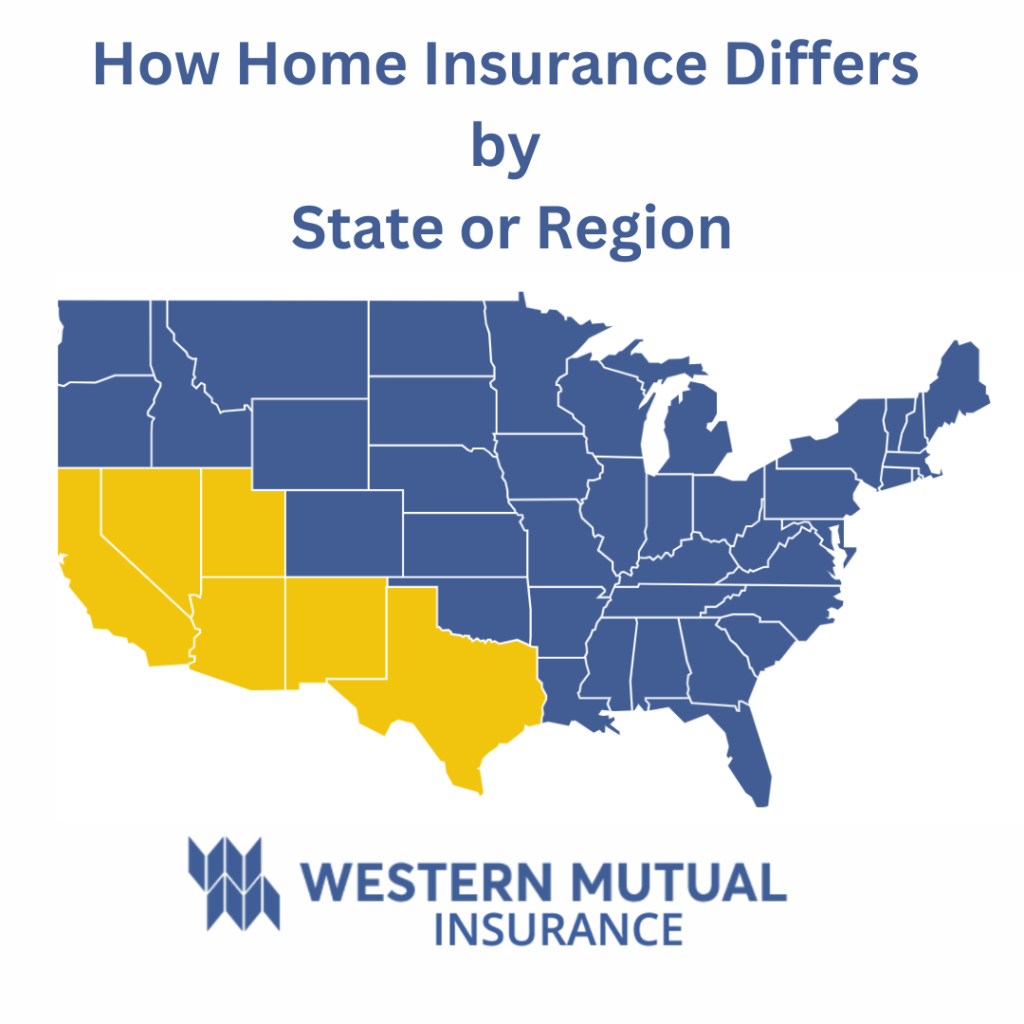
How Home Insurance Differs by State or Region

Home insurance varies significantly by state or region due to differences in geography, climate, local regulations, and risk factors. Here are the key factors that contribute to these variations: 

1. Geographic Risks 

Natural Disasters: States prone to specific disasters often have higher premiums or require additional coverage: 

Hurricanes and Flooding: Coastal states like Florida, Texas, and Louisiana often have higher rates due to hurricane risks. Policies may require separate windstorm or flood insurance. 

Earthquakes: States like California and Alaska may require earthquake insurance, which is typically not included in standard policies. 

Wildfires: High-risk areas like California, Oregon, and Colorado often see higher premiums or reduced availability due to wildfire exposure. 

Tornadoes: States in Tornado Alley, such as Oklahoma and Kansas, might have specific endorsements for wind and hail damage. 

2. State-Specific Regulations 

Coverage Requirements: Some states mandate specific types of coverage or insurance limits, affecting pricing and policy offerings. 

Insurance Regulation: States like New York may have stricter consumer protection laws, impacting how policies are priced, and claims are processed. 

State Insurance Pools: In high-risk areas, states may offer special programs, like Florida’s Citizens Property Insurance Corporation, for homeowners unable to find coverage on the private market. 

3. Cost of Construction and Materials 

Areas with higher labor costs or more expensive materials (e.g., urban areas like New York or California) may have higher premiums. 

Regional building codes can influence costs; for instance, hurricane-prone areas may require more robust construction. 

4. Crime Rates 

High-crime areas may face increased premiums due to higher risks of theft or vandalism. 

5. Market Competition 

States with a larger number of insurance providers tend to have more competitive rates. Conversely, areas with fewer providers may see higher costs due to limited options. 

Examples of Regional Differences: 

Region Key Factors Affecting Insurance 

Northeast: Snow damage, older homes, high rebuilding costs 

Southeast: Hurricanes, flooding, high humidity risks (mold) 

Midwest: Tornadoes, hail, flooding near rivers 

West Coast: Earthquakes, wildfires, high property values 

Mountain West: Wildfires, snow damage, lower population density 

Southwest: Drought, heat damage, flash flooding 

Understanding these differences can help homeowners select appropriate coverage and budget for insurance expenses effectively.  

Visit us online at WestenMutual.com.